Showing posts with label IJN. Show all posts

14/04/2025

Anime "Fuku-chan's Submarine" = Fuku-chan no Sensuikan = フクチャンの潜水艦 (1944)

Fuku-chan is a character from the comic strip of the same name by Ryuichi Yokoyama, which was so popular that it was published from 1936 until 1971.


During the Pacific war Fuku-chan obviously "went to war", appearing in three military animes.


In the anime "Fuku-chan's Submarine" (1944), he and his friends serve on the submarine "I-1" and dashingly defeat US enemies.

See full anime below:


Mind you, that’s not ordinary propaganda cartoon. I don't know, who studied the IJN submarines so thoroughly when creating it - but in this anime you can see a lot of details of service on a submarine: from attacking an enemy convoy to cooking in the galley, from a duel with an enemy submarine to replenishing supplies.
Cartoon shows many details. For example, after refueling the submarine, the hose is not simply disconnected - a cap is put on the fuel neck, and the pit with the neck is closed with a special hatch. It feels like the anime authors had a real submariner as a consultant.


The purely artistic part is also interesting. With primitive graphics (the norm in anime of that time), two combat missions with a lot of details were packed into half an hour. The characters does not look primitive, despite the fact that there are almost no dialogues in the anime. The almost complete absence of PATHOS!!!! in a product of military propaganda is also interesting. Not once characters cry ubique "Banzai!".


For the anime fans I will add, that for the first time in the history of Japanese anime all songs were specifically written for this anime, and not taken from somewhere else. Yes, the entire anime music industry traces its lineage to "Fuku-chan's Submarine".
The song about the submarine galley (潜水艦の台所) is still sung by Japanese submariners:


Also this anime shows you the coolest picture of the "Big Ben" - US aircraft carrier USS "Franklin" (CV-13):


20/06/2024

Battle of the Philippine Sea - can you afford your battle plan?

Battle of the Philippine Sea 80 years ago (19–20 June 1944) wrecked carrier aviation of the Imperial Japanese Navy.

Much was told about qualitative and quantitative superiority of the US Navy in this battle. Indeed, those were a factor in battle. 

Less is told about battle tactics of the opposing commanders.


Spruance’s tactics of “wait and see” was unimaginative. But he could afford it, after all IJN simply had to come to Saipan to save IJA garrison, where USN was waiting in force.


Ozawa’s tactics of outranging the enemy and aiming not for sinking the enemy carriers, but for eliminating their flying decks, was very bold and novel. But could he afford it?

To find the enemy at great distance Ozawa needed good reconnaissance crews. Which he didn’t have. As a result a lot of his force was simply wasted due to errors of recce crews.


To eliminate many US carriers’ flying deck at once, IJN strike groups were ordered to spread into many targets – failing to hit a single US carrier.  BTW, much-praised US fighters failed to intercept a single attack against US CVs.


After the defeat Ozawa bemoaned, that his force was of poor quality and was unable to fulfill his bold plans. That’s true. But isn’t it commander’s duty to make plans according to the actual quality of his force and not some fantasies?


17/06/2024

When lawyers decide on warship building

 When lawyers decide on warship building.

"Akagi" postcard from https://www.oldtokyo.com/


Based on her early photo without turrets.

See the upper hangar has open sides? Why is this? After all, wet surrounding is not the best place to store aircraft.

The reason for this is LEGAL. At postcard’s bottom is an official displacement of "Akagi" – 26500 tons. Within the limits of Washington Naval Treaty. What if your ship is going to be above the treaty limits? – You remove walls of upper hangar and declare hangar not a part of the hull, but upper deck with rain cover in from of the flying deck. Such arrangement does not count against ship’s displacement.

I’d really like to know the name of the lawyer, who came up with this idea.

This arrangement wouldn’t last long. It turned out no Washington Naval Treaty member was eager to make a fuss over some minor treaty violations, so in a year sides of upper hangar were plated to ensure proper aircraft storage (see 1930 photo below).


Some more photos and postcards of "Akagi" in 3-flying deck configuration:


09/05/2024

Midway Battle 1942 - Myth on unwise IJN battle deployment

I was surprised to find out, that some people really believe IJN plan for Midway operation was to send Nagumo’s carriers into US ambush, while deliberately keeping other forces too far away to help. 

Of course, this is incorrect. IJN forces were to be spread broadly only during an approach march. For battle IJN forces to be organized into 3-5 mutually supporting groups. Their deployment to be covered with submarine picket lines (crimson dotted line) and air reconnaissance, which covered whole area of planned battle with US fleet (yellow dotted line). See planned IJN disposition for the battle with US fleet - in crimson.


Of course, IJN had no idea that USN was reading their codes and waited for IJN in an ambush. So part of IJN fleet was ambushed and destroyed during pre-battle operations. And USN was too cautions to get lured into ambush, organized by IJN as “plan B”. So IJN had to withdraw.

I expect a logical question: why IJN couldn’t approach battle area in few mutually supporting groups? It could hardly help Nagumo’s carriers, but “plan B” could be played much better. The reason is weird belief of IJN leadership, that USN is lacking will to fight. If the whole might of IJN will arrive to Midway, US fleet will “chicken out” and remain in Pearl Harbor.

So the bait was necessary: big enough to send whole US fleet to defeat it, but small enough to be easily defeated by US fleet. Nagumo’s carriers and Kondo’s cruisers were this bait. And the rest of the IJN fleet has to hide until US fleet will approach Midway.

This was the reason for IJN forces spreaded so broadly during an approach march – even if US submarine will find one group by accident, it won’t be able to report the actual strength of whole fleet.

This part of IJN plan actually worked – USN was unable to uncover full IJN order of battle and thought IJN forces were much smaller, than they actually were. The irony – this lack of knowledge allowed US commanders act way bolder, then if they knew they are facing almost whole IJN fleet.


20/04/2024

Two capstone moral education documents of the Japanese military


On http://Rikukaigun.org I've added two capstone moral education documents of the Japanese military:
Every Japanese soldier was expected to learn those two documents by heart and the Imperial Rescript was to be memorized by every IJA member (by contrast IJN required learning, not memorization, of the Imperial Rescript).

10/12/2023

“Rikusentai” by Austin Adachi - a small review


Land combat component of the Imperial Japanese Navy is poorly researched in modern English-language literature. The book “Rikusentai” by Austin Adachi tries to correct this.

Despite small size, book gives reader good overall picture about IJN land forces (not just SNLFs – there were many IJN land formations, either intended or forced to fight on land): their creation, evolution, organization, uniform, weapons and equipment. Also it has many quality photos, which were never published before. And printing quality is excellent – the book is pleasure to read.


The only thing missing is combat history of IJN land units. But even a short description of combat operations will require at least several volumes of the “Rikusentai” size, so I can understand, why author decided to cut his description of combat operations down to the most general words.

As a researcher I’m also pleased, that, despite small size of the book, author found some space for the sources of his knowledge, which greatly helps people who’d like to find more on the topic.


In my opinion the book “Rikusentai” is a great work on topic despite its small size. 


Austin Adachi is also the head of the Japanese Naval Landing Forces Historical Preservation Association. It’s web site has a lot of interesting Japanese photos (sometimes totally unlike your average Pacific War Japanese photos): https://en.rikusentai.net/ 


01/07/2023

Elevator covers on Japanese aircraft carriers

Click on the pictures below to enlarge them


There were discussions on various internet forums about the purpose of platforms on top of after elevator wells of IJN aircraft carriers "Akagi" (see above), "Kaga" and "Ryujo".

Usual answer was - those are double elevators, similar to those on HMS "Ark Royal".I’ll show, that those are not double elevators, but 後部飛行機昇降台上部覆 = "after elevator top covers", placed to protect after elevator from being damaged by landing plane. It was impossible to lower them below level of flying deck.
 
Look at my drawing to see how it operated:


But were those things actually elevator covers?
Let’s start with the "Ryujo". I have several drawings of this ship, which say exactly the same thing: this ship had no double-level after elevator, but single-level elevator with a special elevator cover.


At the top view of "Ryujo" after elevator you can see 4 "ears", that protruded outside the elevator well to ensure elevator cover won’t fall at the bottom of the elevator well (see below). 

The same "ears" can be seen on the after elevators of both "Akagi" (upper photo below) and "Kaga" (lower photo below).


On 1939 drawing of "Akagi" we can see see, that single-level middle elevator (captioned #90) is drawn in upper position flush with flying deck. Single-level aft elevator (also captioned #90) is at the bottom of the elevator well. BUT what's at at the top of the after elevator well? It is not captioned, but can be only elevator cover.


I’ve yet to see any official explanation for such an arrangement in any book on IJN aircraft carriers. But it’s not hard to guess, why it was used. After elevator area was the place, where aircraft have landed on those carriers. Even early aircraft were heavy and hit the deck hard. Apparently Japanese engineers were afraid, that such "kicks" will break after elevators, so they installed safety covers. Only the first IJN aircraft carrier "Hosho" received no such cover - probably because its landing area begun aft of the after elevator (see picture below).


The next generation of IJN carriers ("Soryu" (see picture below) and "Hiryu") also had their landing areas after the after elevators. Also by the time they were designed Japanese engineers, apparently, become sure the new elevator stoppers will be enough to prevent any accidents. So elevator covers never again appeared on IJN aircraft carriers.


Note, that elevator covers were retained on "Akagi", "Kaga" and "Ryujo" right to their sinking in 1942 (on the frame below elevator cover can be seen on "Kaga" (on the left side of the movie frame) in December 1941).


Sources: “Ryujo” drawings from S.Fukui collection (Kure Maritime Museum), “Akagi” drawing (Maru hardcover, drawings supplement, volume 1), H.Lengerer “Aircraft Carriers Of The Imperial Japanese Navy And Army” – Vol.1, Mechanism of Japanese Aircraft Carriers, Wikipedia photos.

11/12/2022

No, he is not a kamikaze


Today I've learned, that one of the most iconic photo of kamikaze pilots shows no kamikaze :) This is 2nd class Petty Officer OISHI Hideo, assigned to the IJN 12th Kokutai (air group). The photo was taken sometime around August 1940 so he is not a kamikaze pilot. He is probably a fighter pilot - behind him is a tail of A6M fighter. Another incorrect caption of the Japanese photo :( Thank you, Tony Feredo, for the correct photo caption. 

06/12/2022

IJN Kido Butai (“Mobile Force”) launching the striking force on Pearl Harbor on the early morning of 7 December 1941

Great artwork showing carriers of IJN Kido Butai (“Mobile Force”) launching the striking force on Pearl Harbor on the early morning of 7 December 1941. Without this force outstanding speed of early was Japanese offensives was simply impossible.


One-man “Yamato spirit”, ridiculed so often by historians…


IMHO, foundation of IJN success at Pearl Harbor on 7 December 1941 was an unwavering belief of one man – Admiral Yamamoto – that attack could be done. Even pessimists felt obliged to work their best to make attack work. One-man “Yamato spirit”, ridiculed so often by historians…

13/11/2022

3 Japanese books on IJN carriers

The author, who goes by the pen-name "Kaz" of the dojinshi circle “Reppu-Kai”, is writing books about technical and operational details of IJN aircraft carriers.

His books are small (some 30 pages each) and have no photos.

It’s the text of those books that made me to overcome all the hassles of buying books in Japan and shipping them to Ukraine, as well as translating them.

Author research is about very narrow topics, but he studies them in great depths, using many original period sources. 

Add to this small, but clear drawings by the author, and you’ll get invaluable books for the IJN carriers’ researcher.

More about each book.

“Carrier Force Reconstruction Plan” (空母部隊再建計画).


After the defeat at Midway in June 1942 IJN tried really hard to regain its carrier superiority. You can find information about carrier-building programs in English-language sources. But this books studies something lightly described even in Japanese – ideas how to make and use IJN Carrier Task Forces from Midway till the end of the war.


“Aircraft Carrier Aircraft Capacity Situation. Enlarged and Revised Edition” (空母飛行機搭載状況 増補改訂版).


IJN carriers aircraft-carrying capacity, air groups’ compositions from 1930s till 1945, capacity of flying decks of the ships to launch and recover aircraft.


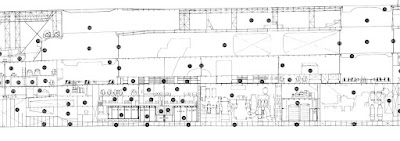
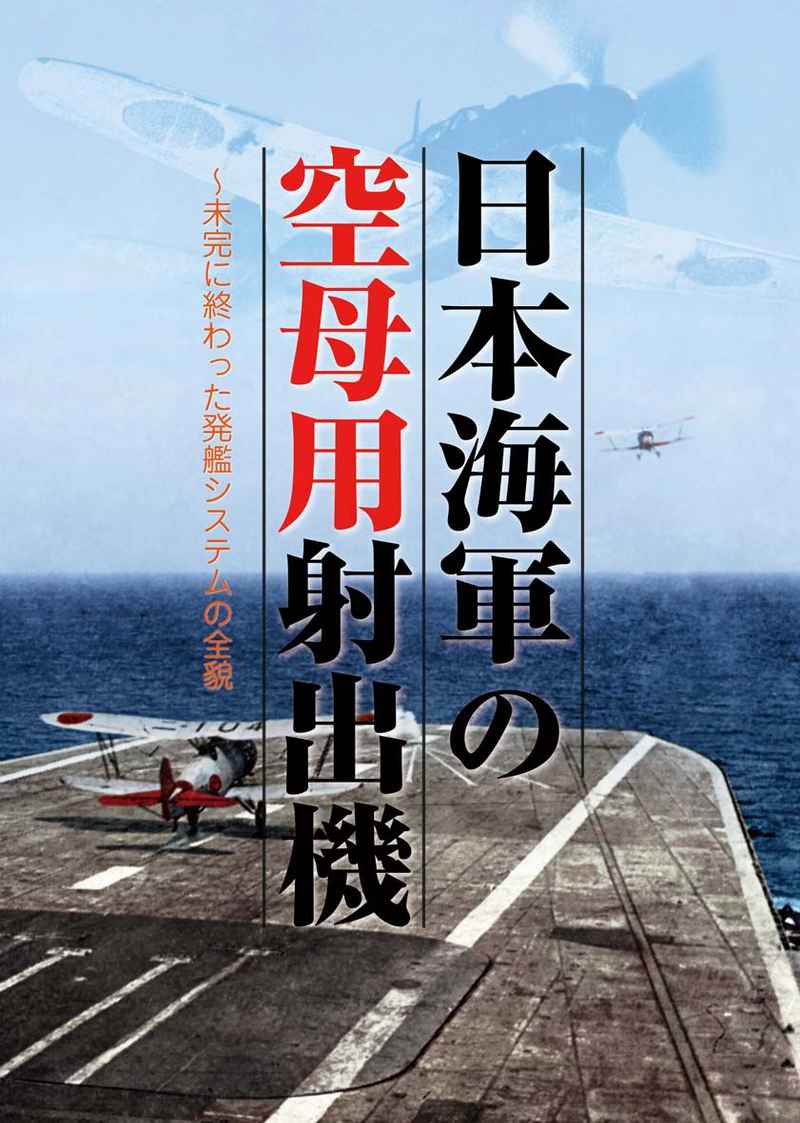
“Japanese Navy aircraft carrier catapults” (日本海軍の空母用射出機).


Description of various attempts to install catapults aboard IJN aircraft carriers. IJN did worked on various designs of catapults for their aircraft carriers, yet the only catapults that saw operational service, were ones installed on battleship-carriers of “Ise” class.


One of the drawings from the later book: design of carrier catapult from c.1940-41.

23/10/2022

Mysteries about IJN carrier strength expansion plan of 1942

 Japanese defeat at Midway on 4-6 June 1942 brought very painful understanding of the importance of the Kido Butai - Carrier Task Force. So Japanese Navy very quickly created a plan to rebuild it, adopting new carrier strength expansion plan on 30 June 1942.

According to the plan, main strength of the new Kido Butai were to compose improved versions of already existing designs: 5 large carriers of the “Taiho” class (with armored flying deck) and 13 medium carriers of the “Unryu” class. To together with original “Taiho” and “Unryu”, that were already building, it provided for 20 carriers = 3 heavy and 7 medium carrier divisions.


Aircraft carrier “Taiho” 

Aircraft carrier “Unryu” 


For details see attached table 7.5 from the book “Japanese Cruisers of the Pacific War” by Lacroix and Wells (with some of my clarifications added):


The problem was – building large warship is neither fast nor easy. As a result main strength of the plan to be completed only in 1947(!). So IJN had to improvise, doing quick conversion of other ships in order at least to regain pre-war carrier force strength before new carriers will enter service. 6 ships were chosen for conversion plus 3 more were added later. Other battleships and heavy cruisers were considered, but eventually ideas of their conversion were abandoned due to the need of those ships as they were.

As you can see, according to the above table IJN can’t even achieve December 1941 level of aircraft strength aboard fleet carriers (that is, excluding 4 slow CVs: “Shinyo” and “Taiyo” class) before mid-1944. And IJN expected the number of US fleet aircraft carriers (CVs, CVLs) will be 12 by the end of 1943 (compare with 7 CVs in December 1941).

So the question of “quick and dirty” increase of carrier strength till 1945 at least was of paramount importance for the IJN. There is little use of new carriers if the fleet is already defeated. As it happened in real life in 1944. Of course, lack of carrier capacity is definitely not the only reason for Japanese defeats, yet it’s one of the obscure ones, usually limited to the usual explanations of Japan’s industry problems. But industry did its best: “Taiho” and first 3 “Unryus” were completed before planned dates. Yet it was still too late, as only “Taiho “was able to take part in Philippine Sea Battle against US carrier task force in June 1944.

That’s why the first two years of IJN carrier strength expansion plan of June 1942 worth more careful study.  Could IJN do better there, than in the original plan?

All 1942 FY ships of the plan are pre-Midway plans and little extra could be done here (to be precise “Chuyo” orders to start conversion were issued after Midway battle (on 21 June 1942), but planning for conversion was obviously done before the battle).

Among 1943 FY ships initially there were only two warships: “Chitose” and “Chiyoda”. They were both built as seaplane carriers (CVS) with construction allowing for conversion into carrier. So they were to be converted into CVLs which can carry some 30 planes each. Looks good – until we find out, that at the same time IJN desperately tried to attend lack of seaplane capacity of the fleet. Cruiser “Mogami” and oiler “Hayasui” received expanded seaplane facilities. Later on “Ise” class battleships and “Tamano” class oilers were also to receive capability to carry seaplanes and even launch carrier aircraft from special trollies. All this added no carrier decks, but at the same time relieved carriers from such tasks as reconnaissance, anti-submarine patrols, etc. And new seaplane fighters and dive-bombers allowed for support of the regular carriers in combat. Each plane, doing such job from the board of the CVS, relieved a plane aboard CV for other mission.

Now the mystery: why to convert existing seaplane carriers into regular carriers if you still need seaplane carriers??? In mid-1942 there were 3 high-speed CVS in the IJN: “Chitose”, “Chiyoda” and “Nisshin” (last two were converted into midget submarine carriers, but still could carry seaplanes on the upper decks). Instead of quick re-conversion of two ships into CVS, “Chitose” and “Chiyoda” were converted into carriers while “Nisshin” remained to be used as fast transport without any plans for its CV conversion. In my opinion, “Chitose”, “Chiyoda” and “Nisshin” with some 20 seaplanes each would’ve been way better addition to the fleet, then converted “Mogami”, “Ise” and “Hyuga”. And the conversion times will be way shorter.


 “Chitose” as seaplane and regular aircraft carrier


Now about other ships in this plan: “Kaiyo” (ex-“Argentina Maru”) and “Brazil Maru”. Together with other 4 CVs, converted from merchant ships, they are often called “escort carriers” – which is incorrect. Those 2 ships were to receive destroyer turbines so they could operate with “Junyo” class CVs and older battleships. But this never happened. Just like planned conversion of 3 ships of the “Asama Maru” class along the same lines. Some other ships can follow, each carrying c.20 planes. Of course, those ships weren’t as good, as purpose-built carriers. But they were there and could bring up IJN fleet carrier strength by 100-plus aircraft by mid-1944.


Aircraft carrier “Kaiyo”


Another mystery is lack of progress with aircraft carrying fast oilers of “Hayasui” and “Tamano” classes, also ordered in 1942. Of 15 ships planned only “Hayasui” was completed. They were too complicated for mass production? – Why not to build something similar on the base of standard 1TL wartime standard tankers?


Model of "Tamano" oiler


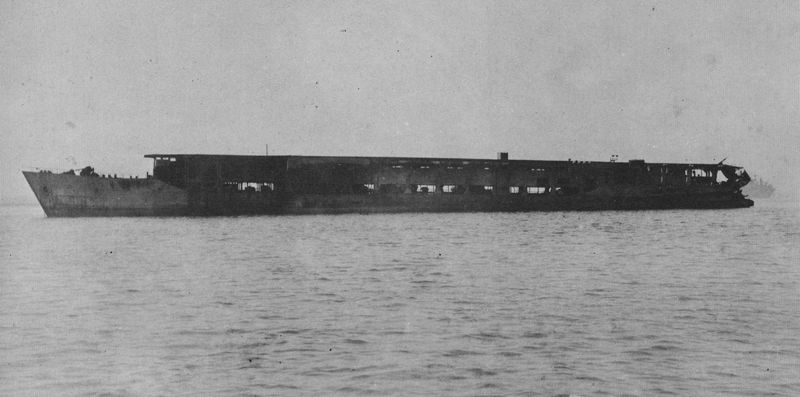
But the biggest mystery of them all in this 1942 plan is a total lack of anything resembling carriers, built on the hulls of wartime standard ships. After Midway there was a special study about merchantmen, converted into carriers to transport aircraft. Even if they had little value for the fleet battle, they can relieve fleet carriers from transport missions, convoy escort and other secondary duties. But only in 1944 few such ships were planned, but even then at first as Merchant aircraft carriers, which continued to carry cargo and operated under civilian command with small military aircraft detachment aboard. Only later some of them become full-fledged escort carriers. The most surprising – the driving force behind this was apparently not Japanese Navy, but Japanese Army.


IJA "Yamashiro Maru" post war. Forward part of flying deck removed after the war


One can say all those change doesn’t matter. IJN was doomed to lose from the beginning of the war due to the disparity of strength with its enemies. May be. But it doesn’t mean we shouldn’t research the decisions made by the Japanese Navy to see if they were optimal or not.

Eugen Pinak 

23 October 2022