Showing posts with label Pacific War. Show all posts

14/04/2025

Anime "Fuku-chan's Submarine" = Fuku-chan no Sensuikan = フクチャンの潜水艦 (1944)

Fuku-chan is a character from the comic strip of the same name by Ryuichi Yokoyama, which was so popular that it was published from 1936 until 1971.


During the Pacific war Fuku-chan obviously "went to war", appearing in three military animes.


In the anime "Fuku-chan's Submarine" (1944), he and his friends serve on the submarine "I-1" and dashingly defeat US enemies.

See full anime below:


Mind you, that’s not ordinary propaganda cartoon. I don't know, who studied the IJN submarines so thoroughly when creating it - but in this anime you can see a lot of details of service on a submarine: from attacking an enemy convoy to cooking in the galley, from a duel with an enemy submarine to replenishing supplies.
Cartoon shows many details. For example, after refueling the submarine, the hose is not simply disconnected - a cap is put on the fuel neck, and the pit with the neck is closed with a special hatch. It feels like the anime authors had a real submariner as a consultant.


The purely artistic part is also interesting. With primitive graphics (the norm in anime of that time), two combat missions with a lot of details were packed into half an hour. The characters does not look primitive, despite the fact that there are almost no dialogues in the anime. The almost complete absence of PATHOS!!!! in a product of military propaganda is also interesting. Not once characters cry ubique "Banzai!".


For the anime fans I will add, that for the first time in the history of Japanese anime all songs were specifically written for this anime, and not taken from somewhere else. Yes, the entire anime music industry traces its lineage to "Fuku-chan's Submarine".
The song about the submarine galley (潜水艦の台所) is still sung by Japanese submariners:


Also this anime shows you the coolest picture of the "Big Ben" - US aircraft carrier USS "Franklin" (CV-13):


20/06/2024

Battle of the Philippine Sea - can you afford your battle plan?

Battle of the Philippine Sea 80 years ago (19–20 June 1944) wrecked carrier aviation of the Imperial Japanese Navy.

Much was told about qualitative and quantitative superiority of the US Navy in this battle. Indeed, those were a factor in battle. 

Less is told about battle tactics of the opposing commanders.


Spruance’s tactics of “wait and see” was unimaginative. But he could afford it, after all IJN simply had to come to Saipan to save IJA garrison, where USN was waiting in force.


Ozawa’s tactics of outranging the enemy and aiming not for sinking the enemy carriers, but for eliminating their flying decks, was very bold and novel. But could he afford it?

To find the enemy at great distance Ozawa needed good reconnaissance crews. Which he didn’t have. As a result a lot of his force was simply wasted due to errors of recce crews.


To eliminate many US carriers’ flying deck at once, IJN strike groups were ordered to spread into many targets – failing to hit a single US carrier.  BTW, much-praised US fighters failed to intercept a single attack against US CVs.


After the defeat Ozawa bemoaned, that his force was of poor quality and was unable to fulfill his bold plans. That’s true. But isn’t it commander’s duty to make plans according to the actual quality of his force and not some fantasies?


09/05/2024

Midway Battle 1942 - Myth on unwise IJN battle deployment

I was surprised to find out, that some people really believe IJN plan for Midway operation was to send Nagumo’s carriers into US ambush, while deliberately keeping other forces too far away to help. 

Of course, this is incorrect. IJN forces were to be spread broadly only during an approach march. For battle IJN forces to be organized into 3-5 mutually supporting groups. Their deployment to be covered with submarine picket lines (crimson dotted line) and air reconnaissance, which covered whole area of planned battle with US fleet (yellow dotted line). See planned IJN disposition for the battle with US fleet - in crimson.


Of course, IJN had no idea that USN was reading their codes and waited for IJN in an ambush. So part of IJN fleet was ambushed and destroyed during pre-battle operations. And USN was too cautions to get lured into ambush, organized by IJN as “plan B”. So IJN had to withdraw.

I expect a logical question: why IJN couldn’t approach battle area in few mutually supporting groups? It could hardly help Nagumo’s carriers, but “plan B” could be played much better. The reason is weird belief of IJN leadership, that USN is lacking will to fight. If the whole might of IJN will arrive to Midway, US fleet will “chicken out” and remain in Pearl Harbor.

So the bait was necessary: big enough to send whole US fleet to defeat it, but small enough to be easily defeated by US fleet. Nagumo’s carriers and Kondo’s cruisers were this bait. And the rest of the IJN fleet has to hide until US fleet will approach Midway.

This was the reason for IJN forces spreaded so broadly during an approach march – even if US submarine will find one group by accident, it won’t be able to report the actual strength of whole fleet.

This part of IJN plan actually worked – USN was unable to uncover full IJN order of battle and thought IJN forces were much smaller, than they actually were. The irony – this lack of knowledge allowed US commanders act way bolder, then if they knew they are facing almost whole IJN fleet.


10/04/2024

Organization of 244th Air Group, IJA Air Force - 1943 & 1945

For more details see on Rukaigun.org my translation of the Japanese article "Regarding the organization of 244th Air Group" by Sakuari Takashi, which describes organization of the IJA Air Force fighter unit.


244th Air Group Organization as of 1943
-------------------------
244th Air Group Organization from January to March 1945


16/12/2023

With vibrator - to victory!


During the Pacific War Japanese bureaucrats sometimes did ridiculous things to ensure "proper morals" were maintained by Japanese, as morals were considered important factor to win the war.

Among other things this meant women should've abstain from sex even as their husbands were in the military and away from home - sometimes for years.


So Japanese military decided to produce vibrators for women whose husbands were at the front. But once a model had been chosen and a factory established, authorities were unable to market this product to married women. Why? - Because advertising vibrators was banned as "immoral" by other bureaucrats.

Those who think I've invented all this - please look at pages 63-64 of the book "The thought war - Japanese imperial propaganda" by Barak Kushner.


10/12/2023

“Rikusentai” by Austin Adachi - a small review


Land combat component of the Imperial Japanese Navy is poorly researched in modern English-language literature. The book “Rikusentai” by Austin Adachi tries to correct this.

Despite small size, book gives reader good overall picture about IJN land forces (not just SNLFs – there were many IJN land formations, either intended or forced to fight on land): their creation, evolution, organization, uniform, weapons and equipment. Also it has many quality photos, which were never published before. And printing quality is excellent – the book is pleasure to read.


The only thing missing is combat history of IJN land units. But even a short description of combat operations will require at least several volumes of the “Rikusentai” size, so I can understand, why author decided to cut his description of combat operations down to the most general words.

As a researcher I’m also pleased, that, despite small size of the book, author found some space for the sources of his knowledge, which greatly helps people who’d like to find more on the topic.


In my opinion the book “Rikusentai” is a great work on topic despite its small size. 


Austin Adachi is also the head of the Japanese Naval Landing Forces Historical Preservation Association. It’s web site has a lot of interesting Japanese photos (sometimes totally unlike your average Pacific War Japanese photos): https://en.rikusentai.net/ 


06/12/2022

IJN Kido Butai (“Mobile Force”) launching the striking force on Pearl Harbor on the early morning of 7 December 1941

Great artwork showing carriers of IJN Kido Butai (“Mobile Force”) launching the striking force on Pearl Harbor on the early morning of 7 December 1941. Without this force outstanding speed of early was Japanese offensives was simply impossible.


One-man “Yamato spirit”, ridiculed so often by historians…


IMHO, foundation of IJN success at Pearl Harbor on 7 December 1941 was an unwavering belief of one man – Admiral Yamamoto – that attack could be done. Even pessimists felt obliged to work their best to make attack work. One-man “Yamato spirit”, ridiculed so often by historians…

23/10/2022

Mysteries about IJN carrier strength expansion plan of 1942

 Japanese defeat at Midway on 4-6 June 1942 brought very painful understanding of the importance of the Kido Butai - Carrier Task Force. So Japanese Navy very quickly created a plan to rebuild it, adopting new carrier strength expansion plan on 30 June 1942.

According to the plan, main strength of the new Kido Butai were to compose improved versions of already existing designs: 5 large carriers of the “Taiho” class (with armored flying deck) and 13 medium carriers of the “Unryu” class. To together with original “Taiho” and “Unryu”, that were already building, it provided for 20 carriers = 3 heavy and 7 medium carrier divisions.


Aircraft carrier “Taiho” 

Aircraft carrier “Unryu” 


For details see attached table 7.5 from the book “Japanese Cruisers of the Pacific War” by Lacroix and Wells (with some of my clarifications added):


The problem was – building large warship is neither fast nor easy. As a result main strength of the plan to be completed only in 1947(!). So IJN had to improvise, doing quick conversion of other ships in order at least to regain pre-war carrier force strength before new carriers will enter service. 6 ships were chosen for conversion plus 3 more were added later. Other battleships and heavy cruisers were considered, but eventually ideas of their conversion were abandoned due to the need of those ships as they were.

As you can see, according to the above table IJN can’t even achieve December 1941 level of aircraft strength aboard fleet carriers (that is, excluding 4 slow CVs: “Shinyo” and “Taiyo” class) before mid-1944. And IJN expected the number of US fleet aircraft carriers (CVs, CVLs) will be 12 by the end of 1943 (compare with 7 CVs in December 1941).

So the question of “quick and dirty” increase of carrier strength till 1945 at least was of paramount importance for the IJN. There is little use of new carriers if the fleet is already defeated. As it happened in real life in 1944. Of course, lack of carrier capacity is definitely not the only reason for Japanese defeats, yet it’s one of the obscure ones, usually limited to the usual explanations of Japan’s industry problems. But industry did its best: “Taiho” and first 3 “Unryus” were completed before planned dates. Yet it was still too late, as only “Taiho “was able to take part in Philippine Sea Battle against US carrier task force in June 1944.

That’s why the first two years of IJN carrier strength expansion plan of June 1942 worth more careful study.  Could IJN do better there, than in the original plan?

All 1942 FY ships of the plan are pre-Midway plans and little extra could be done here (to be precise “Chuyo” orders to start conversion were issued after Midway battle (on 21 June 1942), but planning for conversion was obviously done before the battle).

Among 1943 FY ships initially there were only two warships: “Chitose” and “Chiyoda”. They were both built as seaplane carriers (CVS) with construction allowing for conversion into carrier. So they were to be converted into CVLs which can carry some 30 planes each. Looks good – until we find out, that at the same time IJN desperately tried to attend lack of seaplane capacity of the fleet. Cruiser “Mogami” and oiler “Hayasui” received expanded seaplane facilities. Later on “Ise” class battleships and “Tamano” class oilers were also to receive capability to carry seaplanes and even launch carrier aircraft from special trollies. All this added no carrier decks, but at the same time relieved carriers from such tasks as reconnaissance, anti-submarine patrols, etc. And new seaplane fighters and dive-bombers allowed for support of the regular carriers in combat. Each plane, doing such job from the board of the CVS, relieved a plane aboard CV for other mission.

Now the mystery: why to convert existing seaplane carriers into regular carriers if you still need seaplane carriers??? In mid-1942 there were 3 high-speed CVS in the IJN: “Chitose”, “Chiyoda” and “Nisshin” (last two were converted into midget submarine carriers, but still could carry seaplanes on the upper decks). Instead of quick re-conversion of two ships into CVS, “Chitose” and “Chiyoda” were converted into carriers while “Nisshin” remained to be used as fast transport without any plans for its CV conversion. In my opinion, “Chitose”, “Chiyoda” and “Nisshin” with some 20 seaplanes each would’ve been way better addition to the fleet, then converted “Mogami”, “Ise” and “Hyuga”. And the conversion times will be way shorter.


 “Chitose” as seaplane and regular aircraft carrier


Now about other ships in this plan: “Kaiyo” (ex-“Argentina Maru”) and “Brazil Maru”. Together with other 4 CVs, converted from merchant ships, they are often called “escort carriers” – which is incorrect. Those 2 ships were to receive destroyer turbines so they could operate with “Junyo” class CVs and older battleships. But this never happened. Just like planned conversion of 3 ships of the “Asama Maru” class along the same lines. Some other ships can follow, each carrying c.20 planes. Of course, those ships weren’t as good, as purpose-built carriers. But they were there and could bring up IJN fleet carrier strength by 100-plus aircraft by mid-1944.


Aircraft carrier “Kaiyo”


Another mystery is lack of progress with aircraft carrying fast oilers of “Hayasui” and “Tamano” classes, also ordered in 1942. Of 15 ships planned only “Hayasui” was completed. They were too complicated for mass production? – Why not to build something similar on the base of standard 1TL wartime standard tankers?


Model of "Tamano" oiler


But the biggest mystery of them all in this 1942 plan is a total lack of anything resembling carriers, built on the hulls of wartime standard ships. After Midway there was a special study about merchantmen, converted into carriers to transport aircraft. Even if they had little value for the fleet battle, they can relieve fleet carriers from transport missions, convoy escort and other secondary duties. But only in 1944 few such ships were planned, but even then at first as Merchant aircraft carriers, which continued to carry cargo and operated under civilian command with small military aircraft detachment aboard. Only later some of them become full-fledged escort carriers. The most surprising – the driving force behind this was apparently not Japanese Navy, but Japanese Army.


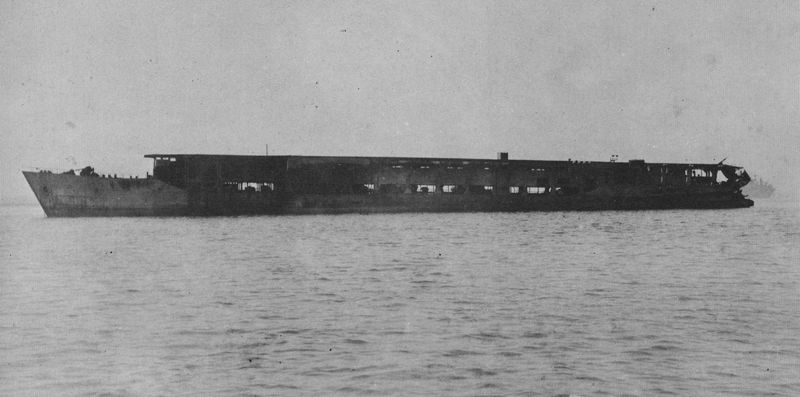
IJA "Yamashiro Maru" post war. Forward part of flying deck removed after the war


One can say all those change doesn’t matter. IJN was doomed to lose from the beginning of the war due to the disparity of strength with its enemies. May be. But it doesn’t mean we shouldn’t research the decisions made by the Japanese Navy to see if they were optimal or not.

Eugen Pinak 

23 October 2022

09/10/2022

Japanese official histories of the Pacific War


The box cover of one of the volumes of “Sensi Sosho”.

After the surrender of Japan in World War II, the US intelligence personnel found themselves in a very comfortable position. The US occupation administration simply gave an order - and the Japanese authorities quickly organized the writing of the history of the Second World War in the Pacific from the Japanese point of view in order to make it easier for American researchers to work on American history of the Pacific War.

Unfortunately, from the triad “fast, cheap, high quality – chose two of three” the Americans decided to dispense with “high quality”. As a result, the first Japanese history of WWII, better known by its name in English as “Japanese Monographs”, was largely a victim of haste.

First, the monographs differed in quality: from the general history of military transport throughout the war to the description of the capture of a small island. The monographs themselves were small at first, apparently due to the tight deadlines for writing. Where it turned out to be necessary to describe a serious issue, the authors worked in the style of “novel in the newspaper” - they divided the topic into chapters and proceeded them in turn one by one. There was no unified editing of proofreading. Over time, the haste has subsided, and later Monographs were begun to resemble monographs in size and detailed description of the topic.

The Monographs themselves are largely paraphrases or quotations from official documents. Which is not surprising, since the authors simply did not have the time for serious analysis and synthesis. 

Moreover, not everything, that needed to be written, was actually written. For example, there is no Monograph on the Battle of Midway and the attack on Pearl Harbor (the monograph on Pearl Harbor is actually just a collection of documents). As I understand it, this was due to the fact that the people, who could write these monographs, were working directly with the Americans. In addition, not everything, that the Japanese wrote, was translated into English.

The English language of monographs, by the way, is a problem in itself. Of course, even a bad translation is better than no translation - which explains the popularity of monographs among non-Japanese researchers to this day. But this does not change the fact that the Monographs were translated by a variety of translators, who did not worry about the consistence of the translation of terminology, place names, etc. Moreover, there are specific errors in the translations, especially in the names of ships and the names of people, which are not so easy to translate from Japanese.

As a result, in the mid-1950s US personnel was tasked with editing and proofreading the translations of some of monographs. But interest in them faded, so only part of the monographs was edited.

Brief history of creation, list and description of monographs (sometimes very critical):

https://oregondigital.org/sets/easia/oregondigital:df72dt655#page/1/mode/1up

Texts of Japanese Monographs online: https://pacificwararchive.wordpress.com/2019/01/27/japanese-monographs/

==========

The shortcomings of the Japanese Monographs were already obvious at the time of their writing, so the Japanese Institute of Military History begun to make a better quality history of the Pacific War. The process was led by Hattori Takushiro, former Chief of Operations of the General Staff of the Imperial Japanese Army.

8-volume work “The Complete History of the War in Great East Asia” = 大東亜戦争全史, published in 1953-56, turned out to be a book of a completely different level than the Japanese Monographs - the quality of the authors’ work is evident here. But there are questions here as well. First, history is written almost exclusively from the Army's point of view and at a strategic level. There were simply not enough resources to describe tactical actions. Secondly, the officers of the General Staff were not inclined to particularly analyze or criticize their own actions.

Nevertheless, this work was a quality research which turned out to be quite popular for a book on such peculiar topic. Japanese edition has been reprinted twice and had also been translated into English and Chinese. Its’ abbreviated version was translated into Russian under the title “Japan at War” (very rare thing for Japanese book). However, not everything was translated - the tender souls of Soviet propagandists could not stand the encounter with the real description of the Japanese campaign in Manchuria in 1945, so they simply threw it out of the book, replacing it with a condemning philippics against “falsifications” in the style of the editorial of the “Krasnaya Zvezda” newspaper (official newspaper of the Soviet Army).

==========

Meanwhile former officers of the Imperial Japanese Navy also worked on better quality history of the Pacific War, named “Nippon Kaigun Senshi” = “War History of the Japanese Navy” = 日本海軍戦史. In 1950 at least 11 small volumes were published. But those volumes were, in fact, improved versions of the Japanese Monographs, which hardly looked impressive compared to “The Complete History of the War in Great East Asia” then in the making.  That’s why this project was abandoned.

==========

It is clear that the Institute of Military History was not going to stop after the release of Hattori’s book. There, work continued on the new Japanese history of WWII, known as the “Senshi Sosho” = “Military History Series” = 戦史叢書. Work has accelerated sharply after most of the documents, confiscated by the USA after the war, were returned to Japan in the mid-1960s.

But Japanese military historians were not going to limit themselves to documents. Numerous veterans were involved in the work, who could use their diaries (during WWII, keeping a diary was considered almost an integral part of the life of an educated Japanese) and documents in their possession (which sometimes were not available elsewhere). Moreover, draft versions of the chapters of the new history were actively discussed, and veterans, who were directly related to these events, also participated in the discussions.

The first volume of “Sensi Sosho” was published in 1966, the last (102nd) - in 1980. 2 more volumes with collections of documents were published in the mid-1980s.

The work on “Sensi Sosho”, which lasted for almost thirty years, brought very positive results. This time both army and navy points of view on the war were recorded for the posterity. In these volumes there was a place not only for strategies, not only for operations, but also for describing actions at the tactical level. A huge advantage compared to previous histories was that at least some mentions of the sources of the information have finally appeared which were not present in previous versions.

But in fairness, it should be noted that this version of Japanese official history was not without flaws. A very sad division into history from the Army point of view and history from the Navy point of view has been preserved. One and the same operation can be described in two volumes: army and navy - and described in different ways. And sometimes aviators also insert their point of view. At the same time, even in dry lines, one sometimes feels a desire to hurt, to show flaws of the opposite service.

The Japanese did not succeed in creating a single, unified concept of the description of the Second World War in the Pacific. Each volume is a “thing in itself”, and one volume may well contradict with another.

It would be useful to note the simple fact that the history of the war, written by the participants, contains a lot of valuable details - but usually completely devoid of any critical view of events. Not every person is able to engage in self-criticism, while understanding perfectly well that it will be recorded in the history book. On the other hand, given the paucity of the documents, available to the authors of official history, the mass recruitment of veterans with their diaries/documents was the best way to solve the problem. And for a historian, the saddest thing is the lack of a full-fledged reference apparatus, which makes it very difficult to verify the source of the particular information.

Despite its historical value, “Senshi Sosho” has hardly been translated into other languages. One volume (about the “Battle of a Hundred Regiments” in North China) was translated into Chinese in the Peoples Republic of China, and four complete volumes plus parts from five other volumes were translated into English.


Text of all volumes of "Senshi Sosho" in Japanese: http://www.nids.mod.go.jp/military_history_search/


A) Translation on my web site:

Volume 24 "Naval Offensive Operations towards the Philippines and Malaya" (1941-1942) - published on my web site with the kind permission of the translator Pedro Brandão from Portugal: https://rikukaigun.org/SS-24/SS-24_Philippines-Malaya.htm


B) Australian translation (parts of Volume 14 and Volume 28 on IJA operations in Papua-New Guinea): http://ajrp.awm.gov.au/ajrp/ajrp2.nsf/Web-Pages/JapaneseOperations?OpenDocument


C) US translations - partial - by Rear Admiral Edwin T. Layton:

Volume 49 "Naval Operations in the South East Area Vol. 1" (incomplete): https://www.usnwcarchives.org/repositories/2/archival_objects/58379

Volume 83 "Naval Operations in the South East Area Vol. 2" (Until the Withdrawal from Guadalcanal):

Part 1: https://www.usnwcarchives.org/repositories/2/archival_objects/58385

Part 2:  https://www.usnwcarchives.org/repositories/2/archival_objects/58386


D) Dutch translations:

Volume 3 "The invasion of the Dutch East Indies" (IJA operations): https://library.oapen.org/handle/20.500.12657/32880

Volume 26 "The Operations of the Navy in the Dutch East Indies and the Bay of Bengal" (IJN operations): https://library.oapen.org/handle/20.500.12657/28411

Volume 34 and part of the Volume 5 "The Invasion of the South" (Operations of the IJA Aviation): https://library.oapen.org/handle/20.500.12657/48379

===============

Unfortunately, this is where the Japanese decided to end the official writing of the history of WWII in the Pacific. With the exception of identifying and correcting errors in the “Senshi Sosho”, there is no new work on the academic history of World War II in Japan.  

==============

Unfortunately, this is where the Japanese decided to end the official writing of the history of WWII in the Pacific. With the exception of identifying and correcting errors in the “Senshi Sosho”, there is no new work on the academic history of World War II in Japan.